Ligament Lift in Apgujeong, Gangnam, SeoulTargeted ligament support and broader lifting around the SMAS
Ligament Lift visibly lifts sagging contours without surgery. Supportive injectable materials are placed at selected points around the facial retaining ligaments, with more flexible materials distributed around the SMAS, the facial fascia beneath the skin. It is an effective option for people hesitant about a surgical facelift or thread lift.

Before adding volume to a sagging area, I examine the ligaments that hold the face in place.
 Dr. Chang-Hwan Cho First author of a review on collagen boosters
- Results
- Visible right away
- Duration
- Lasts 12 months or more
- Comfort
- Mild discomfort
- Recovery
- Usually settled by the next day
- Treatment time
- Around 20–30 minutes
- Treatment areas
- Temples, midface and jawline
Collagen develops gradually afterward
Numbing cream
Swelling, bruising and tenderness usually settle
Excluding numbing time
Also the eyes, nasolabial folds and mouth area
Restoring support
for your facial contours

Age-related sagging involves more than a loss of skin firmness. As tension in the retaining ligaments and fibrous tissue weakens, they hold the skin and soft tissue less securely. The temples, eye area, midface, mouth and jawline can then drop.
After assessing the anatomy around the main retaining ligaments and SMAS, your doctor reinforces selected support points and connects sagging or hollow areas with broader injections. This supports surrounding skin and soft tissue for more defined contours, beyond simply filling hollows.
Lifts sagging temples, cheeks and jawline

Temples and eye area
Improves sagging around the temples and eyes. Targeted reinforcement around weakened retaining ligaments supports tissue that has dropped.

Midface and front of the cheeks
Lifts the midface and front of the cheeks. Broader treatment connects sagging and hollow areas, raising surrounding skin and soft tissue together.

Below the cheekbones
Improves hollowness and sagging beneath the cheekbones by adding volume where it is missing and support where tissue has dropped.
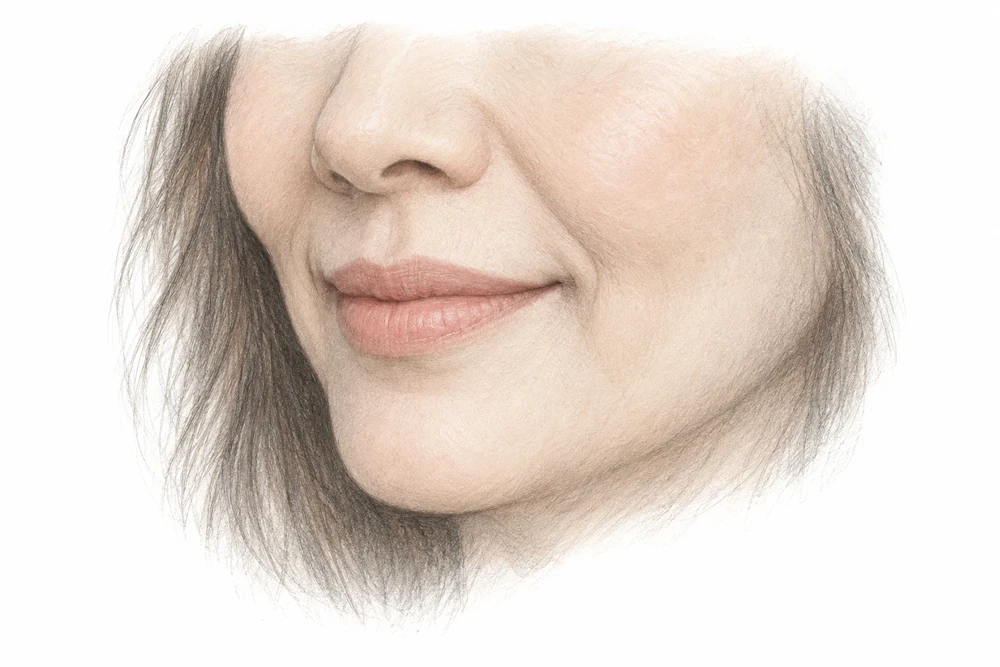
Nasolabial folds and mouth area
Refines the nasolabial folds and area around the mouth, making deeper, heavier-looking contours appear lighter.

Jawline & facial contours
Improves a sagging jawline and restores definition to blurred facial contours.

Support and dimension
Improves support and firmness across the face. Continued collagen renewal in the subcutaneous layer creates natural-looking facial dimension.
Non-surgical lifting, planned by your doctor
Care from the first author of a collagen booster review
Injectable lifting results depend on how treatment is planned and performed. We take time with every patient. A doctor handles your consultation and performs your treatment personally.
Teaching collagen stimulation from the dermis to the ligaments
Dr. Chang-Hwan Cho lectured at ASLS Vietnam Hanoi 2025 on stimulating collagen from the dermis to the ligaments, and at ASLS Seoul 2025 on choosing collagen stimulators for the temples, cheeks, nasolabial folds and other facial areas.
Published comparisons of collagen booster mechanisms
Dr. Chang-Hwan Cho was first author of a 2026 Journal of Cosmetic Dermatology review comparing six collagen boosters, including CaHA, PLLA and PCL. These distinctions inform his choice of material for each face.
Treatment by doctors who teach CaHA techniques
Dr. Chang-Hwan Cho and Dr. Soyoun Koo were recognized as outstanding trainers in the second module of Merz's RADIESSE Train the Trainer program. RADIESSE is a CaHA product used in this injectable lift.

How can a sagging face be lifted without surgery?
Your doctor will assess whether it is right for you
- You are hesitant about a surgical facelift or thread lift
- Sagging around the temples and eyes bothers you
- Your midface and cheeks appear to have dropped
- Nasolabial folds and the mouth area look deep or heavy
- Your jawline has lost definition
- You want a natural-looking lift without excessive volume
- You want to address the upper, middle and lower face together
- You want facial movement and expressions to remain natural
Ligament Lift:
The materials at a glance
Materials differ in how they support tissue and how quickly they stimulate collagen. Your doctor chooses according to your face and the area being treated.
| Ingredients | Material | Immediately after treatment | Over time |
|---|---|---|---|
| NASHA | Nonanimal stabilized hyaluronic acid | Stable tissue support and volume for hollow areas | Strong shape retention reinforces support around retaining ligaments |
| CaHA | Calcium-based material similar to components of bone and teeth | Tissue support and immediate volume | Collagen stimulation improves firmness and density |
| PCL | Biodegradable polymer biostimulator | Supplements tissue | Gradual breakdown supports continued collagen stimulation |
| PLLA | Biostimulator that encourages collagen production | Primarily stimulation rather than immediate volume | Stimulates fibroblasts to form new collagen |
| LMWHA | Low-molecular-weight hyaluronic acid | Improves hydration within the skin | Supports ECM remodeling to improve firmness, density and texture |
How injectable lifting supports sagging tissue
Your doctor explains how it works
Retaining ligaments are fibrous structures connecting skin, fat and fascia to support facial tissue. As tension around them and firmness in the subcutaneous tissue decline, the cheeks and jawline sag. A doctor who has taught collagen stimulation from the dermis to the ligaments maps the support points and broader treatment areas for your face.

Reinforcing ligament support points
Small amounts of supportive material are placed around the fascial layer to supplement tension in the fibrous tissue.
Broader lifting around the SMAS
Elastic, flexible material is distributed evenly across an area to connect and support sagging tissue.
Subcutaneous collagen renewal
Collagen-stimulating materials placed beneath the temples and outer cheeks gradually restore firmness.
Lifting sagging contours, area by area
A plan for each treatment area
 TemplesAround the eyesFront of the cheeksOuter cheeksNasolabial foldsMouth areaJawline
Other options for sagging and volume loss
Results, comfort and recovery at a glance
Compare injectables and thread lifts side by side. The right choice varies from person to person, so your doctor will help you decide at your consultation.
| Treatment | Results | Duration | Comfort | Recovery |
|---|---|---|---|---|
| Ligament Lift | Visible right away | Lasts 12 months or more | Mild discomfort | Usually settled by the next day |
| Outline Contour Lift | Visible right away | Lasts 12 months or more | Mild discomfort | Usually settled by the next day |
| RADIESSE | Visible right away | Lasts 24 months or more | Mild discomfort | No downtime |
| Sculptra | Gradual improvement | Lasts 24 months or more | Mild discomfort | Usually settled by the next day |
| Thread Lifting | Visible right away | 9+ months | Mild discomfort | 3 days of downtime |
Lifted contours before an important date
Treatment timed around your plans
From actors preparing for filming to patients planning a wedding or presentation, many people visit us ahead of an important date. Your doctor plans the timing and combination of treatments around your facial features and schedule.

If your event is tomorrow
Leave enough time before your event for any swelling or bruising from the injections to settle. If the date is very close, your doctor may recommend treatments with no downtime instead.
If your event is a month away
We work backward from your event date to plan a course of lifting treatment. Our broad range of devices lets us choose a combination that suits your face.
Your treatment day, step by step
Your doctor oversees anesthesia and treatment
Your doctor handles both your consultation and treatment. A patient coordinator can help with pricing.
Doctor consultation and facial assessment
Your doctor assesses the sagging areas and retaining ligament support.
Mapping points and treatment areas
Ligament support points and lifting areas are planned for your facial structure.
Numbing cream
Numbing cream helps ease discomfort from the injections.
Injectable lifting treatment
Supportive materials are placed at selected points, with flexible materials spread across broader areas.
Post-treatment care
After soothing and moisturizing care, we explain how to manage swelling.
Preparation and aftercare
Aftercare
- Temporary swelling, redness, tenderness or bruising can occur at the injection sites, but usually settles during recovery.
- Do not press firmly on or massage the treated area.
- Avoid saunas, steam rooms, alcohol and strenuous exercise for about 1 week.
- Follow your medical team's instructions for gentle cleansing, makeup and care of the treated areas.
- Contact the medical team immediately for severe pain, changes in skin color or other unusual symptoms.
A Dong-An Joongsim Clinic doctor presenting collagen boosters at a conference
Conference lectures and seminars with doctors from around the world.


Treatments that can complement a ligament-based lift
Outline Contour Lift can be added when sagging at the jowls, jawline or outer cheeks is also a concern. It focuses on lifting the outer facial contours.
Explore Outline Contour Lift →This collagen booster uses CaHA, one of the materials available for this injectable lift. It can extend firming treatment to neck lines.
Explore RADIESSE →This collagen booster uses PLLA, another material option for ligament-based lifting. It can extend firming treatment across the face and to the neck, backs of hands and body.
Explore Sculptra →Facial sagging and support: insights from our doctors
Our doctors explain sagging and facial support in clear, practical terms.

Is Adding Volume Enough to Treat Facial Sagging? An Anatomical Assessment of Facial Aging II
Facial aging occurs across several layers at once, including bone, fat, muscle, dermis and epidermis.
Dr. Chang-Hwan Cho
Is Lifting Alone Enough for Jowls? An Anatomical Assessment of Facial Aging III
Lower-face changes reflect bone structure, fat-pad position, ligaments, muscle imbalance and declining ECM quality together.
Dr. Chang-Hwan Cho
Why Nasolabial Folds and Eye Wrinkles Develop: An Anatomical Assessment of Facial Aging
The skin around the eyes is much thinner than skin elsewhere on the face, so wrinkles often appear there first.
Dr. Chang-Hwan ChoInjectable lifting: results, side effects and pricing
Answers from our doctors
How do I choose a Ligament Lift clinic in Apgujeong, Gangnam, Seoul?
Ligament Lift results depend on how treatment is planned and performed. Check whether a doctor handles consultation and treatment, whether genuine products are used, and whether treatments can be combined to suit your face. We take time with every patient, with a doctor leading your consultation and performing treatment personally.
Why does the face sag when retaining ligaments weaken?
Retaining ligaments connect the skin, fat and fascial layers to support facial tissue. Aging reduces both skin firmness and tension in these ligaments and fibrous tissues. As their hold weakens, the temples, eye area, midface, mouth and jawline can drop, making facial contours less defined.
Is Ligament Lift the same as ligament filler?
Both place supportive material around retaining ligaments. Ligament Lift also distributes flexible material broadly around the SMAS and adds collagen-stimulating material beneath the temples and outer cheeks. The aim is to reinforce facial support as well as fill hollows.
How does Ligament Lift differ from Outline Contour Lift?
Outline Contour Lift focuses on the outer face, such as the jowls, jawline and outer cheeks. Ligament Lift assesses the main retaining ligaments and SMAS to address the upper, middle and lower face together, including temples, eyes, midface, mouth and jawline. Its material options add NASHA and LMWHA to CaHA, PCL and PLLA.
Could it suit me if I am hesitant about surgery or threads?
This is an injectable option for people who find a surgical facelift or thread lift too much. Small amounts are placed at ligament support points and across lifting areas without incisions. Your doctor assesses sagging and facial structure before recommending an approach.
When will I notice results?
Materials such as NASHA and CaHA support tissue immediately, so sagging contours may feel supported right away. Over time, PCL, PLLA and LMWHA encourage collagen production, gradually improving firmness and support within the skin.
Could my face look overfilled or my expressions look unnatural?
Small amounts are placed at ligament support points, while flexible materials are spread evenly around the SMAS. The plan is intended to give a natural lift without excessive volume or awkward facial movement.
What side effects can this injectable lift cause?
Temporary swelling, redness, tenderness or bruising can occur and usually settles during recovery. Avoid firm pressure or massage, and avoid saunas, steam rooms, alcohol and strenuous exercise for about a week. Contact the medical team immediately for severe pain, changes in skin color or other unusual symptoms.
How is Ligament Lift priced?
The price depends on the number of ligament support points, the extent of the lifting areas, and the materials and amounts used. Your doctor assesses your facial structure and completes the plan before we discuss cost.
Which materials are used, and what about safety?
Your doctor selects from NASHA, CaHA, PCL, PLLA and LMWHA according to your face and the treatment area. The materials used in Ligament Lift hold US FDA, European CE and Korean MFDS certifications covering safety and effectiveness.
Materials used in Ligament Lift
| Materials | NASHA · CaHA · PCL · PLLA · LMWHASelected according to facial assessment |
|---|---|
| Treatment layers | Around retaining ligaments · SMAS · Subcutaneous tissuePlaced at points and across broader areas |
| Method | Injectable liftNo incisions |
| Certifications | FDA · CE · MFDSFor the materials used |
A natural, visible lift, planned for your face by your doctor
We take time with every patient. Your doctor leads the consultation and performs the treatment, with a plan based on your face.
Sources
- Cho CH·Yanagawa A·Kim B, J Cosmet Dermatol 2026;25:e71105 (DOI) ↗
- Alghoul and Codner, Aesthet Surg J 2013: review of facial retaining ligament anatomy (PubMed) ↗
- Galderma: RESTYLANE's 25th anniversary and NASHA technology, September 2021 ↗
- Merz Aesthetics: RADIESSE (+) launch for jawline contouring, February 2022 ↗
- Galderma: official Sculptra (PLLA) page ↗
- Samyang Biopharm: official Lafullen (PCL) product page ↗